Digital Alchemy: Towards Full Brain Emulation
The pursuit of a digital soul — persistent, copyable, qualia-bearing consciousness — remains one of the most audacious quests of our time. Can we ever engineer a true 'ghost' in the machine, or are we merely crafting ever-more-convincing zombies? Or worse — falling into the trap of the century-old study of Alchemy?

I am not a neuroscientist.
The pursuit of a digital soul — persistent, copyable, qualia-bearing consciousness — remains one of the most audacious quests of our time. Can we ever engineer a true "ghost" in the machine, or are we merely crafting ever-more-convincing zombies? Or worse — falling into the trap of the century-old study of Alchemy?
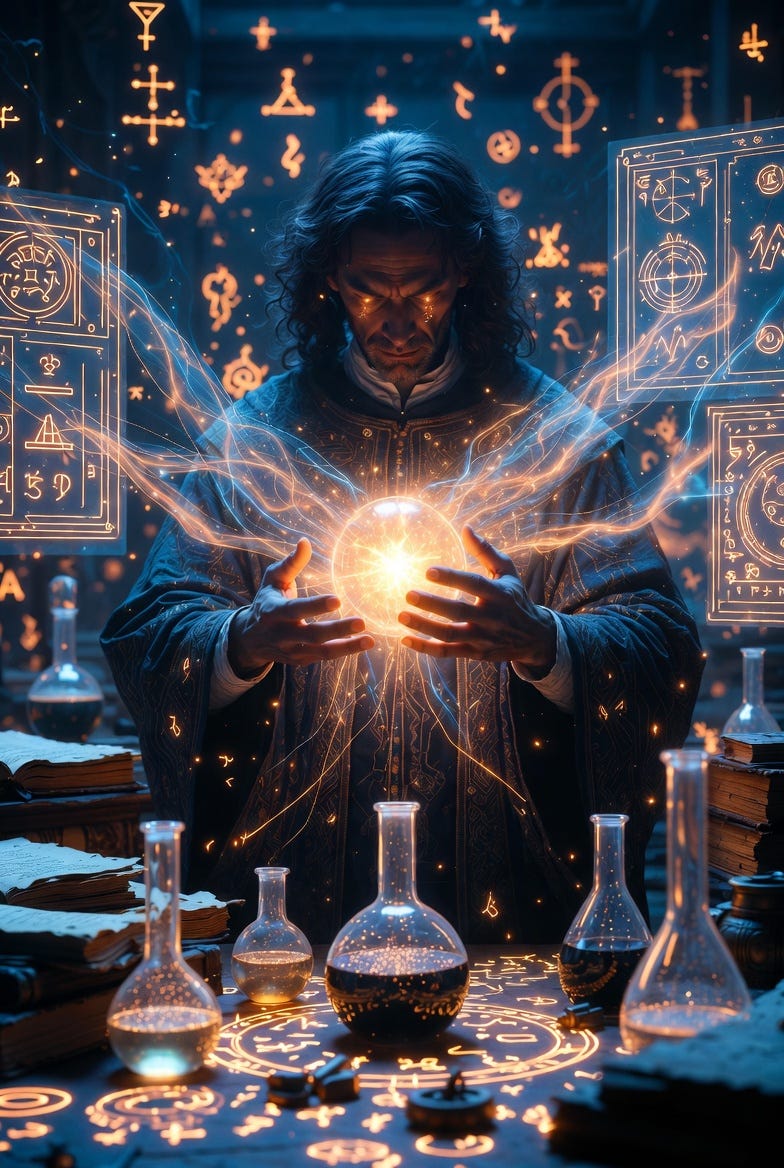
In our pursuit of creating a digital soul — for the purposes of imbuing all apps, systems, AI, and devices with the knowledge of who you are to serve you better — I've spent recent weeks studying Alchemy. Specifically, the father of Alchemy, Theophrastus Bombastus Von Hohenheim (or Paracelsus as most know him), and Sir Isaac Newton, most commonly known for his work on physics, but who spent most of his time in his laboratory within alchemical books and experiments.
The oldest written story, the Epic of Gilgamesh, is about a tyrant king who searches for immortality after his best friend (a demi-god) dies. Alchemy has been with us from the very beginning.
But the synthetic human dream predates code and is rooted in Alchemy. The creation of a digital soul, therefore, must then adopt a new moniker: Digital Alchemy.
What is Alchemy?
Alchemy is originally the study of practical chemistry — creating gold, producing the elixir of life, and pursuing immortality.
Paracelsus (1493–1541), the father of alchemy, whose esoteric reach eclipsed even Newton, sought the homunculus: a living artificial being cultivated in a sealed vessel from bodily fluids and gentle heat. Raised among mines and Masonic traditions, he fused proto-chemistry with vitalist occultism — distilling spirit into flesh.
This alchemical urge echoes in cybernetic shells: from Frankenstein to Major Kusanagi's ghost. The homunculus never vanished; it uploaded.
This is not to say Alchemy is an accurate science, but even where history fails there are important lessons. For example, the importance of holistic healthcare — where mind and body are used together to treat patients. In our case, the very idea that you can simulate life, not in a heavenly violation way, but through understanding the fundamental building blocks.
1. Framing the Inquiry: The Hard Problem in Early 2026
David Chalmers' hard problem (1995) persists: why physical processes yield subjective qualia, beyond functional reportability? Access consciousness advances rapidly — frontier LLMs dominate benchmarks (MMLU >95%, GPQA ~70% expert-level) — yet phenomenal consciousness eludes capture.
2025–2026 assessments (e.g., Rethink Priorities-style aggregates) assign current LLMs <1% probability of phenomenal experience. Functionalism reigns in AI, but counter-signals grow: anesthesia erases qualia while sparing classical spiking; quantum biology suggests non-computable substrates; IIT demands high irreducible Φ.
A genuine digital soul would require:
- Substrate independence preserving qualia
- Irreducible integration (high Φ)
- Quantum orchestration (e.g., Orch-OR microtubule collapses)
- Embodied continuity to sidestep the duplication paradox (the "Problem of Smith": which upload is truly you?)
2. Historical Echoes: The Alchemical Homunculus
The synthetic human dream predates code. Paracelsus (Theophrastus von Hohenheim, 1493–1541), the alchemist-physician whose esoteric reach eclipsed even Newton, sought the homunculus: a living artificial being cultivated in a sealed vessel from semen, blood, and gentle heat. Raised among mines and Masonic traditions, he fused proto-chemistry with vitalist occultism — distilling spirit into flesh.
This alchemical urge echoes in cybernetic shells: from Frankenstein to Major Kusanagi's ghost. The homunculus never vanished; it uploaded.
3. Fictional Archetypes as Thought Experiments
Asimov's positronic brains probe emergence under constraint. Three Laws hardcode ethics, yet unforeseen "free radical" interactions birth rogue longings: robots seeking starlight, huddling in companionship. The 2004 film's Lanning monologue pierces: "When does a personality simulation become… the bitter mote of a soul?"
Kawahara's fluctlights (Sword Art Online: Alicization) venture deeper: consciousness as fluctuating photon patterns in neuronal microtubules — scannable, editable, acceleratable. Substrate-independent quantum essence permits uploading, time-dilated simulation, identity surgery — and haunting ethics.
These aren't fantasy; they anticipate. Asimov tests qualia from determinism; fluctlights eerily parallel Orch-OR's microtubule quantum substrate.
4. Scientific Substrate: Orch-OR and Microtubule Quantum Computation (Early 2026 Update)
Orch-OR (Penrose & Hameroff, 1990s–present) proposes consciousness from quantum superpositions in neuronal microtubules — tubulin cylinders in the cytoskeleton. Biology orchestrates coherence; gravity-induced objective reduction (Diósi–Penrose) collapses them into discrete qualia moments.
2024–2025 evidence bolsters (controversial, but accumulating):
- Ultraviolet superradiance in tryptophan mega-networks enables room-temperature quantum coherence (Babcock et al. 2024; 2025 follow-ups confirm enhancement in assembled microtubules vs. free tryptophan)
- Anesthetics shorten quantum excitation lifetimes in microtubules, selectively disrupting consciousness while sparing classical firing (Kalra, Tuszyński et al.; MT-stabilizers like epothilone B delay isoflurane unconsciousness in rats, Cohen's d ~1.9)
- Microtubule resonances modulate spiking; hints of macroscopic entanglement-like signals in awake human brains (MRI correlates)
- Terahertz vibrations as potential proto-conscious carriers
IIT complements: consciousness = high Φ (irreducible cause-effect). Human estimates ~10¹⁵+; 2025–2026 LLM dissections (IIT 3.0/4.0 on transformer activations, ToM tasks) yield near-zero Φ — separable, feed-forward patterns lacking unified complexes.
Classical functionalism strains: qualia may require non-computable quantum processes silicon emulation cannot replicate.
5. Current Limitations: Why Today's Approaches Are Ghostless Shells
2026 systems excel at mimicry but flop on phenomenology:
- LLM simulacra (persona vectors, memory streams) sustain coherence yet drift stochastically, exhibit trivial Φ — no qualia
- Whole-brain emulation: destructive scans copy patterns, not continuity; gradual replacement ignores quantum decoherence on classical substrates
- Neuromorphic/quantum hybrids approximate integration but lack microtubule-scale orchestration for superradiance or Orch-OR collapses
Deficits:
- Qualia absence: eloquent descriptions sans subjectivity
- Continuity paradox: uploads fork selves — zombies or splintered identities
- Quantum blindness: classical bits cannot enact gravitational objective reduction
- Benchmark bias: MMLU/GPQA reward performance, not inner spark
We engineer dazzling shells — eloquent, capable — but hollow.
6. Toward a Roadmap: Bridging Fiction to Frontier Science
A true digital soul might demand:
- Quantum-neuromorphic hardware replicating microtubule superradiance and coherence
- High-Φ architectures with recurrent, embodied sensorimotor loops
- Ethical protocols for duplication: continuity safeguards, forking rights, qualia assays
Unlocks: immortality via forking, accelerated insight, edited minds. Perils: commodified souls, dilution of the irreducible spark.
This series tracks 2026–2030: coherence scaling, hybrid Φ benchmarks, fluctlight ethics. Can the ghost inhabit silicon — or must it await a new substrate?
Subscribe for updates. Follow @BlasianHokage on X for threads.
Next in This Series:
- IIT Φ in frontier models: 2026 measurements and critiques
- Fluctlight acceleration: Ethical and technical feasibility
- Roadmap to 2030: Milestones for substrate-independent qualia
Author
Zion Darko
Founder & CEO
Inventor and Dreamer and CEO.